Last month I had written a short review of
Canongate's new series - updated creative stories rooted in age-old myths and produced by the current literary superstars like Atwood and Pelevin, in which I had focused on the latter author. Essentially, this was review of a review, based on my previous familiarity with other works by Pelevin, since his
Helmet of Horror was not yet available in the Russian bookstores I frequent. (
Frequent is a euphemism, because this bookstore chain is located up in north Toronto and is not easily accessible.) Having finally ventured into this frostbitten wilderness and purchased the book, I must say that I am impressed.
Perhaps my reaction can be explained by the fact that I have further invested myself in modern cultural theory since my last less satisfying reading of Pelevin's publications, such as
Chapaev and Emptiness or
Generation P a number of years ago. Or perhaps this
kreatiff about Theseus and the Minotaur, as Viktor refers to it, really
is a short, funny, and enjoyable read; its initial simplicity soon transformed into theoretic complexity by the middle of the story.
First and foremost Pelevin's new release is another consistent showcase of his sophisticated humor and postmodern trickery. Both aspects situate the updated myth in our
here-and-now. This is not to say that this book does not posses cultural longevity like cheap mystery novels, but that Pelevin deliberately emphasizes his stylistic methodology. As anticipated, this methodology engulfs the story - from the characters' conversations to the the direction of the plot itself.
At first, the labyrinth embodies the co-existence of different realities pertinent to each participant. In their turn, they manage to interact in real time in cyberspace - after all, the world wide web is not a far stretch from from the intricate pathways of the original labyrinth outlined in Greek mythology. Pelevin lightly mocks our technologically oriented culture by giving them amusing chatroom names like Monstradamus, UGLI 666, and Nutscracker. He even describes a person named Sliff_zoSSchitan, who only communicates in a specific type of Russian internet slang, which focuses on profanity, deliberate spelling errors, and never writing words the same way twice. This chatroom also possesses all the required traits of a typical internet community - a man who knows everything about everything, a religious freak, and a web romance, while Minotaur's servants are thought to be the moderators. Even smilies abound.
In contrast to the bombardment of advanced up-to-date technology, certain personal labyrinths embody rather different realities, whether it be an ancient Minoan setting or a gothic cathedral. The puzzling inscriptions found within the latter are almost reminiscent of a simplified version of the
Name of the Rose.
Pelevin's caricature of the current strains of Western civilization is quite welcomed. For example, as the master of the labyrinth, the Minotaur is also known as Asterisk. However, since it is politically incorrect to refer to the Minotaur as simply Minotaur, the second name - Asterisk should be used. It is additionally politically incorrect to use the name Asterisk; therefore in this case, the name Minotaur should be used. Consequently, the general rule is that each of the names can be used, but only when the other name is meant, respectively. This caricature is also a clear demonstration of the disconnect between the signifier and what it represents. Such eyebrow-raising humor seems to be Pelevin's choice method for introducing token postmodern notions into the specificity of his new novel: "When I hear the word "discourse", I grad my simulacrum", Monstradamus, the know-it-all character states facetiously during a complex discussion regarding the nature of the Helmet of Horror, worn by Minotaur.
The Helmet's characteristics determine the understanding of the labyrinth for the trapped. It appears to be an intricate machine comprised of curiously named components, such as the horns of plentitude, the labyrinth-separator, the lattice of now, and so on. For example, the labyrinth-separator is responsible for the divisions between the past, present, and future, while the bubbles of hope indirectly cause a flood of impressions. The complex interaction between the Helmet's components define Minotaur's existence and therefore affect his domain and its unwilling inhabitants. When searching for a way out, these inhabitants engage in lengthy analyses of issues like virtual reality animation or attempt to determine how the Helmet is able to exist inside its own component.
The Helmet of Horror splits that very singularity, which is, into that very multiplicity, which is not.
Towards the myth's completion, Pelevin almost slips into
being Prigov. His characters' apparently random and entirely insane exclamations at the time of the myth's climax are highly reminiscent of Prigov's mammoth poetic oeuvre in its totality. Prigov's authorial penchant for assuming different personas in his literary and visual projects is somewhat publicized, yet Russia's original postmodernist must not have anticipated that his
Dmitri Becomes X formula would be sabotaged and transformed into
Viktor Becomes Dmitri.
And if Viktor becomes Dmitri and maybe even Umberto for a split second, then who becomes Theseus, and where is Ariadna?
:-)
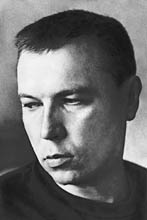
 I didn't even recognize him until he began speaking, shaved face and all. He seems to really dislike publicity photos and has a Baudrillard-like attitude toward the media. The presenters greedily emphasized that Travels in Hyperreality predated Simulacra and Simulation. I wasn't surprised, considering how the latter is academically privileged over the former across the board.