Showing posts with label ussr. Show all posts

15 January 2009

Putin's pro-natalism meets format television

Close to the end of his second term, the now-former president Vladimir Putin publicly began to emphasize the severity of the demographic crisis in the Russian Federation. The media often describes Putin as the man who had brought short-term stability to that country through oil and gas revenue. Journalists also argue that his main goal is to reclaim the so-called great power status for Russia within the international arena. Yet, as Putin himself had announced, the state's efforts may only be sustained by a healthy population growth. (See my May-06 blog No Children. No Future.)

Instead, the opposite is true. After the collapse of the USSR, millions of ethnic Russians remained in the former Soviet republics - from the Baltic to Kazakhstan. More important, Russia's death rate (in part - a result of alcohol-, tobacco-, and pollution-related factors) significantly exceeds its birth rate. Combined with a Gastarbeiter-migrant flood from the former non-Slavic Soviet territories and beyond, the state became rather alarmed (its seeming lack of effort to repatriate those ethnic Russians notwithstanding).

It is not uncommon for the modern government to be actively involved in promoting pro-natalism, most overtly in an immediate postwar setting. (See Mary Louise Roberts' article "The Dead and the Unborn: French Pronatalism and the Abortion Law of 1920", for example.) A new state may also require a growing population to physically sustain its industry and mentally uphold its ideals. (See David Hoffman's Stalinist Values: The Cultural Norms of Soviet Modernity, 1917-1941 about state advocacy of strong, patriarchal families in the 1930s.) What, then, was Putin's solution to the Russian demographic crisis?

Most immediately, the now-former president's pro-natalist program involved various types of financial benefits granted to new and future mothers. While critics scoffed at the program's long-term effects, there was a spike in the Russian birth rate last year. Less obviously, the state has been attempting to construct and promote a new Russian identity through various means, including the consolidation of history teaching in schools. (One has to consider that from the mid-1930s and until 1991, Soviet schools taught a curious blend of ethnocultural patriotism and dialectic materialism. By contrast, many texts published in the 1990s went too far in the opposite direction.) Most recently, a plethora of blockbuster films regarding accepted patriotic subjects, including Alexander Nevsky and the Polish invasion of Moscow in 1612, has been released.

Yet, I wondered whether the state would use mass cultural methodology to address the subject of children more directly. And, it did!

While post-Soviet Russian television had borrowed much from its North American counterpart, including the proliferation of reality content, it also exhibits certain differences. For example, one of the most popular types of content to broadcast is a series, which is essentially an extended film with no possibility of a sequel. This format ranges from as few as four to as many as sixteen episodes. Expectedly, all such series are driven by plot and advertising alike. Here, Russia's "serious" film actors and A-list celebrities frequently play major roles. So, their star power combined with exciting, unrealistic plots, is capable of attracting a wide audience.

One such four-part series is Atonement - Starting All Over. Marta. (Искупление - Начать сначала. Марта.) - an over-the-top, sappy "chick-flick". Maria Poroshina (known to the North American audiences through her role in Night Watch and Day Watch) plays Marta. An attractive, successful forty-something, this woman evaluates her life: she recalls that success did not come easily: abandoned by her husband, she spent years in poverty. One of the ways in which she had earned money was through...........surrogate motherhood. Not once. Not twice. THREE TIMES: repopulating the early post-communist Russia one surrogate baby at a time.

Throughout the series, Marta and her best friend debate the pros and cons of being a surrogate mother and have endless discussions about the biological gift of motherhood and the joy of raising children. She searches for the three that she had once carried to term for other parents and tries to have a baby of her own. Most important, Marta reconnects with the prince charming from her past, who uses martial art skills (!) he evidently picked up in Soviet-era Afghanistan (!) to teach the bad guys a lesson or two (or THREE?!). The ending is, of course, very happy.

This particularly terrible example of Russian format television was created by a Russo-Ukrainian production and distribution company, Star Media. One of its major partners is Russia's most prominent state-owned television, the First Channel. The connection between such exaggerated case of pro-natalism is not only conceivable but also - likely.

Whether this type of mass cultural propaganda ends up contributing to the aversion of a demographic catastrophe remains to be seen. I just hope that the Russian state's next effort involves a better screen play.

28 September 2008

Shock-worker

It's been several months since I've even looked at this blog, and my never-updated personal website has been down inexplicably for two weeks. (Web hosting money well spent! And there I was thinking of redesigning it.) I'm amidst transcribing a lengthy interview regarding the unofficial Soviet rock (unfortunately, not metal specifically) music publications for one of my multiple jobs in the pre-"dissertating" stage. Stalinist shock-worker style.

I have an irreconcilable attitude toward being swept into Russia's irreconcilable history by the mere fact of having been born at the USSR's epicenter nearly twenty-eight years ago. Nonetheless, I've always admired the 30s Stakhanovite shock workers, despite having read many a book on Stalinist economics by "free" and Gulag laborers alike. And, it is not so much the peculiar brand of an ambitious work ethic than is motivating, but rather the fact that it fits my lifestyle.

The only way I can maintain the crazy train (not the Ozzy kind) pace that I've signed myself up for is by subscribing to the udarnik technique. So, whereas a normal PhD student would spread the work over a few days, with sleep and socializing-with-other-humans breaks in between, I am going to do this entire job in one go. By choice and no longer by choice.

Whereas the man who mined one hundred and two tonnes of coal in five hours and forty-five minutes may inspire me to do the same via Microsoft Word, the strange reason I came back to the blog has to do with Sex Machineguns. With the help of the Google translator, I've been reading Anchang's blog for the past week (naturally, during my well earned Stakhanovite breaks). Presumably as a result of the automated translator's limitations and my cliched perception, some of the entries sound like haikus. What I really enjoy about his blog (apart from the multiple photos of objects great and small that carry a heavy metal significance), is the fact that this Japanese rock celebrity manages to keep things succinct, frequent, entertaining, sufficiently personal, yet private at the same time (as his status would require). I'm neither succinct, Japanese, nor a celebrity (phew!), but perhaps the South-East Asian rockstar public diary is just what I need to balance out Alexey Stakhanov.

07 May 2006

A National Idea

Komsomol'skaya Pravda.
12-Oct-2005
Searching for a National Idea.
http://www.kp.ru/daily/23594/45470/print/
Translation: mine.


Writer Mikhail Veller: Maybe we should swap the Kuril islands for Crimea and implement a Christian dictatorship.

Having completed his new book The Last Great Chance, this renowed author visited Komsomol'skaya Pravda and told us what this chance entails.

-Mikhail Iosifovich, please tells us - are all of us rossiyane (Note: Russian citizens) or Russians?

-Russians, of course! Because the Russian nation is collective in origin. Even "Moscow", rather than being Slavic, is a Finno-Ugric word "Moskova". Here we have Mordovians, Turkic peoples, Caucasians, and guys of northern Germanic-Scandinavian descent. All of this had been melted together and became the Russian peoples. All great nations have always been collective. Even the concept of "Russians" only emerged under Ivan the Terrible.

-Then why didn't Russians melt Ukraine into their pot? Or at least tiny Estonia?


-Had the Soviet Union existed for another thousand years, then one may have anticipated the assimilation of all people. Because when a person was worth anything or wanted to have a good career in the Russian Empire or in the Soviet Union, he inevitably underwent russification. Everything passed through the Russian language, Russian culture, Russian capital. The Baltics were joined to the Russian Empire somewhat late. And the Soviet Union led rather sparing national politics there.

-What about Ukraine?

-Well, Ukraine is not simply russified, this was the original Rus' - Kievan. If it weren't for the Tartar-Mongolian invasion, this would have been a unified pot of culturally equal slavic principalities. And as a result, all of this would have been baked into a single state, like a layered cake.

-Why did the Empire collapse?

-Because it exhausted itself. Keep in mind that Russia was initially created via the force of weapons, as were all empires in history. Not otherwise. For a thousand years our national idea was the unification of principalities, then the takeover of new territories, then - their "digestion".

And then all of a sudden, the Empire informed all of its subjects that it just so happens that imperial politics are bad, and we are giving up on them. What was there left to do? Only let itself dissipate.

A thief must be jailed

-And what now?

-And now everyone rushed to create a new national idea. But you cannot just make one up. It has to be natural, a problem projected onto psychology of the people.

This problem is yet to be posed. We are offered the following: let us live comfortably with our bellies full, dear Russians. Thanks a lot. Consumerism cannot embody a national idea. Then it's more beneficial to steal a bunch of goods and say - okay, guys, I think I've fulfilled my idea!

Even a mouse wants a good life - to live in a warm burrow with a full granary and to comfortably produce its offspring. Therefore today's idea is simply that of a mouse.

-In that case, please suggest to us something more interesting.

-Russia's national idea can only arise with departure of liberalism, which is the cause of Europe's current demise. An accelerated demise. Because liberalism states: everyone is equal and identical.

In a normal country, however, a murderer hangs, a thief is jailed, a hard worker lives well, while a lazy worker lives poorly. And the one who does not work at all gets the hell out, without stinking up the country or mooching off the welfare system. Or goes to live in a shelter. Into reservations.

-One who does not work, does not get to eat?

-Yes, something like that. As a result, liberalism cultivates parasitism. Not unlike the Roman Empire - bread and entertainment. Where is this empire now? Modern social parasites in Europe are the classic Roman plebeians, who do not wish to work, but wish to lives in accordance with their desires. They demand this via demonstrations. And the government flirts with them, because it wants votes.

-Exactly. People vote for this type of government. Therefore, they must like it.

-Russian people are not fully spoiled by this. They have a different idea. I doubt that you'd print it...

-...well, now we'd certainly have to print it.

-We'll see. To quote a vendor [I met] by the subway - she will be completely satisfied, when oligarchs and parliamentarians are strung up on light posts along the street. That's the kind of national idea that's blooming from below.

Europe will sell us out

-Is Russia not Europe?

-No, it is not Europe, because the very posing of the question garners doubts. No one asks: is Germany - Europe?

-Do you seriously believe that this [concept] is good for Russia?

-Forty years ago it would have been very bad - that we are not Europe. Today - it is good. Today this is our chance. If we were to join Europe, we would not have a single chance left.

When we say that we want to be part of Europe, we really mean that we want to be wealthy and live freely. At the same time we don't want to change our mentality. We do not feel insecure about all things Russian in front of all things French and German.

And if we do join them, do you really think that our mentality would immediately change? No. This [union] will only result in diminished customs control at the border. This is only beneficial to those who send oil, gas, forestry products, and metal to the West.

It, however, is not beneficial to the rest, because our manufacturing sector cannot handle a competion with Europe. We will ultimately become a source of natural resources and nothing more.

-But is it not better to sell ourselves to Europe than be swallowed by China?

-China will compromise with Europe. Europe does not want to fight or even save itself from complete islamification. And when Europe is face to face with a powerful totalitarian state armed to its teeth, it’ll hand Siberia over to China, and that’ll be the end of it. Back in the day, it handed the Czech Republic over to Hitler. Europe does not give a damn about Russian interests.

-Then maybe America will save us?

-Riiiight! America is also afraid of China. But America does not need Europe as a competitor. America would prefer to have Russia against China and Europe. Therefore in reality, Russia is a strategic partner for America.

-But for now it looks like we are better friends with China against the U.S.A...

-That’s just for show. America does not have any territorial grievances with Russia. No ideologic disagreements. Russia does not participate in anything that would outright horrify America. And further more, it is America, not Europe and China, that above all respects power. Russia’s nuclear arsenal is still present. And for the U.S.A. this is a big argument in our favor.

Eastern Orthodoxy must have fists

-What specifically should our national idea involve?

-The preservation of the Christian civilization.

-What are we going to do with muslims, jews, and atheists? Send them to Siberia too?

-They don’t have to be sent anywhere. And no one should be baptized by force either. By “Christianity” I don't refer to the type of religious worship, but rather - societal values. But they are loosened. Why did Christianity conquer ancient Rome? Because Rome became liberal and allowed everything. While Christianity said – none of this crap. This you have to do, but that will send you to hell. Christians had a definite set of values – what is good, and what is evil.

Europe and Russia no longer follow them. This is why Islam is winning. It has definite values. Islam tells you what is allowed and what is not.

This is why, among others, Russia needs an Eastern Orthodox reform. Orthodoxy must become a living religion, rather than a ritual, as it is now, when bureaucrats hold candles next to their lenten mugs, while yawning priests stand nearby, having successfully purchased a candle factory for the occasion.

-What should we do in particular?

-We must walk one step ahead of destiny. It is unnecessary to wait for inevitability. Kuril islands are already lost for Russia. Today we have absolutely no useful purpose for them. We don’t have the money or a reason to maintain serious bases there. And today we can still bargain for these islands, but in 15 years they will be gone free of charge.

The same applies to East Prussia - Kaliningrad region. Its residents don't need Russia. If the EU tells them, "Hey guys, have dual citizenship, have social welfare up to our standards"; oh my God, what a celebration this would cause! Today we can still rent East Prussia to Germans for 49 years. And milk German blood and gold with tankers thanks to this [transaction]. But in 15 years it will leave on its own, and nothing will get milked.

-You are suggesting that we give them away....

-I am suggesting that we receive the maximum out of what we can hope for. These territories are suitcases without handles for us, regardless.

-But when Abkhazia cries out to us, "Hey guys, we are your brothers, we want to live in Russia", for some reason we think, "What would Georgia and Europe say?" Who gives a damn about what Georgia and Europe would say! All that they can really do is freeze our guys' bank accounts in the West. Well, then, we just need to warn our guys - let them return their money to Russia. Otherwise it will be too late.

-What else are you offering to trade?

-Eastern Russia. It is not ours. Only 145 years had passed since Vladivostok's foundation. We need to give up this stuff as concession to the Japanese and the Koreans against China. We need to create a standard brawl between one type of barbarians against the other on our borders. This is how all shrewed governments acted.

However, that, which is ours and is located nearby, becomes part of Russia, without giving a damn about political correctness.

-Crimea, for example...

-Crimea first and foremost! They need to have a referendum. People, of course, will vote for unification with Russia. Then Moscow imposes a visa regime, which must be satisfied. And then there will be a celebration that will greatly exceed that in East Prussia after its return to Germans.

All skin, but no kielbasa

-What will then happen to the organization of the state?

-For now, it has to be a dictatorship, I'm afraid.

-And democracy is absolutely impossible?

-Democarcy is an optimal speed for a car. But when you are stuck in mud, you need extreme measures in order to get back on the road.

-It seems that certain individuals already scream that we almost have a "bloody regime"

-What regime? Please. Our dictatorship is like kielbasa - we've got the skin, but not the kielbasa itself.

-Who will elect the first dicator? The government or the people?

-Representatives of all parties and movements are locked up for a week. They are not allowed to come out, until they elect someone. Otherwise in France we easily find pedigree-lacking corsican Napoleon, while here we get Ryurikovich - prince Trubetskoy, who does not at all show up to Senatsky square during the Decembrists' rebellion.

-Does the dictator have to be Russian?

-Ideally, it's better for him to be Russian and Christian. But, you know, if he really needs to, he can get baptized himself.

-Wouldn't all of this result in ordinary fascism?

-There are 10-12 chances out of 100 that we will reach a dictatorship of a fascistic nature, and this will be very bad.

-What is your dictatorship like?

-Constitutional. My dictator is an unconditional ruler. Not a tyrant, but rather the highest executive person in possession of emergency powers and specific targets for the duration of a rigidly defined term. If you don't leave on the day your term ends - you are outside of the law, have no civil rights, and are an enemy of the people.

-This sounds like GKChP (Note: leaders of 1991 Russian coup)

-GKChP is the diminution of people's rights and the expansionof authorities' rights. A constitutional dictatorship, in contrast, is the rights' reduction of the very bureaucratic apparatus in question. Because in this case the will of the people directly transforms into action via the dictator's will, instead of being skewed when passing the bureaucratic ladder along the way. It is the bureaucrat, who loses his rights.

-And then we will become the greatest country in the world?

-Greater than America - doubtful. America is like a combined world team. It is difficult to compete with such. With China as well. That, however, which was once Europe, can exist in Russia in its best manifestation, once Germany and France no longer exist. It's most important for people to live like people. Throughout history our nobility and later the party elite lived like Europeans, while the rest of the people - like Russian "aboriginals". Essentially, there have always been two peoples within Russia. Euro-Russians and simply Russians. Today this must no longer be the case.

01 January 2006

3234


I like things that shoot. I wear Russian soldiers' patches. I joke that my favorite car is a tank. I'm no military buff, but I enjoy healthy amounts of historic controversy. I love men in uniform, as every real female should. Most important, I am one of those few romantics who still believe that it is dolce et decorum pro patria mori - if the cause is worthy, of course. After all, bellum and bellus do share the stem.

My family history is not particularly militaristic. My Georgian grandfather used his engineering and architectural training to construct bomb shelters during the Second World War. My Russian grandfather spent this war fighting in the navy, though his fondest memories include partying with Americans in northern city Murmansk at the beginning of the war. The latter's son, my uncle, was the only family member to have a successful military career out of his own volition. He was even stationed in one of the most dangerous places on earth - Afghanistan. USSR's participation in this war is justifiably comparable to America's Vietnam, cause- and consequence-wise.


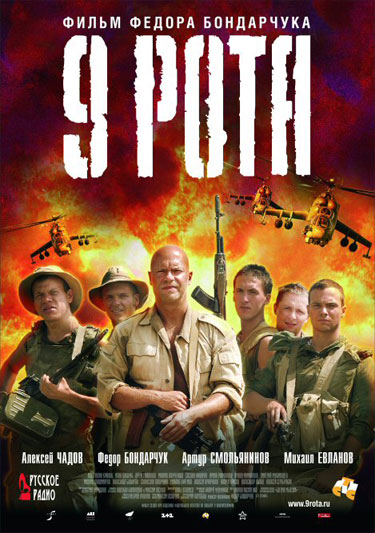
The 9th Company is a film directed and starred by Fedor Bondarchuk about the first Afghan war - its unresolved completion, to be exact. It was released in September 2005 and became an instant highly acclaimed blockbuster. At the same time, this blockbuster status damaged its artistic reputation. For this reason I was quite hesitant about viewing 9th Company. Every review I had read sang accolades to its theme, because this is one of the first films to focus on this war, despite the fact that the last Soviet troops evacuated at the end of the 1980's - a testament to the issue's controversy. That is where the praise ended and criticism began - reviews in mk.ru and gazeta.ru in particular both claimed that the film cut corners, left the characters compactly two-dimensional, and tied the ends into a neat little package, like any true Hollywood aspiration should. Word of mouth, however, had something different to report - in fact, a couple of invidiuals even claimed that the film was so difficult to stomach, that they were unable to sleep afterwards. The weight and the diversity of opinions combined began to overpower the value of 9th Company and made me question whether it was to live up to any of the expectations - good or bad.

The film is loosely historic and covers the end of the first ten year-long Afghan war during the 1987-1989 period. It follows a group of young men from the time they enlist in the army, throughout their brutal training in Uzbekistan, and to their central participation in the Soviet military operations in the region in order to "rid the friendly Afghan nation of imperialism". In Afghanistan itself, the boys are ordered to defend a conquered mountainous territory at the height of 3,234 meters, unaware that the poorly orchestrated war is over, and the troops are being withdrawan, all but their own unit. It has its predictable moments - a physically scarred and psychologically damaged trainee commander, a local whore, or a soldier's first accidental kill. Perhaps such aspects are necessary to demonstrate the non-exceptional, every-man nature of the war's participants.

In the beginning of the movie, a young soldier interrupts a teacher's explanation of Afghanistan's geography, history, religious and multi-ethnic makeup, "Does it really matter whom we fucking waste?"

"Never in the history of the country had Afghanistan been conquered", the teacher replies.

This sense of impending doom in his voice sets the mood for the entire film, even prior to the massacre. Some of the scenes are at least comparable or exceed the brutality of those in the landing in Normandy introduction in another blockbuster like Saving Private Ryan. The neverending rows of the fiercely approaching mujahideen, as the remaining young Soviet soldiers unsuccessfully attempt to fight them off, resemble the army of ghost warriors sprung from seeds in the myth of the Golden Fleece, only these warriors' current relevance is too close for comfort. The knowledge that this war was not only lost by the Soviets, but also entirely meaningless is responsible for the additional psychological enhancement of gore. There is nothing sweet about USSR's 15,000+ deaths, nor did they have much to do with the Fatherland. While there are no sleepless nights to report on my part, the film succeeds in leaving one feeling quite perturbed.

01 September 2005

Off-color commentary on color "revolutions"?

Was reading a not-too-reputable (in my view) ePublication utro.ru today and came across an interview with political scientist Mikhail Leont'ev, in which he made a number of curious comments in regards to the post-Soviet space and consequently the countries that had hosted recent "color revolutions", the Baltics, as well as the relatively "new" states of central Europe such as the Czech Republic, Hungary, and Poland "to a certain extent". Interestingly, he classified most as artificial and having no basis for existence other than the self-establishment of the new nationalistically-minded elites. He used Kievan "dislike" of Russia as such an example and located the foundation for this type of nationalism in, and I quote, "the dumb contrasting of themselves to Russia. After all, they have nothing else!"

Furthermore, Leont'ev highlighted the type of special status that Georgia enjoyed as a Soviet republic due to having rather favorable climatic and financial market factors (tourism and export of goods such as tea, tangerines, wine, and tobacco). With the fall of the USSR, Georgia had been left in shambles; by extension, without its massive neighbor Russia, Leont'iev's prognosis for Georgia was highly negative. He noted that its reliance on American aid as the means of underscoring itself as an entity separate from Russia, is too near-sighted, because Americans are only interested in using Georgia as a transit zone and a pawn in political manipulation (implying countries that truly matter on the world scale, i.e. Russia.).

One could question the man's background, motives, and most important - funding in order to situate this somewhat extreme analysis. This is not my concern. It suffices to state that I am in agreement with a somewhat more moderate variation of this view. It, however, is somewhat bothersome, that Leont'ev lumped countries that had been part of other empires (hence his emphasis on a search of an ethnic identity) like that of Austro-Hungary (or the Russian empire itself) for most of their existence with others, like Poland, which although had been part of the Russo-Germanic power struggle for a considerable time period, had also functioned as an empire itself.

As much as I gloat at his "scholarization" of what I always refer to as the chihuahua syndrome (the smaller and less important is the country (see Baltics)), the louder it has to proclaim its nationalistic values, real or perceived), Leont'ev seemed to have left the justification for a country's existence unclear. That is to say, ethnicity, one of the primary bases for state formation (in the "Old World"), translating into customs - cultural and religious, does not seem to satisfy his requirements for a "non-artificial" country (particularly in the cases of a nation, whose core values were maintained, rather than being assimilated into those of its ruler.)

23 June 2005

7 signs of Russianness

This is really retarded of me to write now, because I don't think I can last much longer. It's 1:30 am, I've been losing a lot of sleep for the past week, and I'm seemingly getting sick. <-AVOIDIG RUN-ONS -> The latter is not a surprise, considering that half of the department is in full sneeze mode, and that I have no immune system. Workouts, carrots, no alcohol, and here we are.

One of my favorite newspapers, Izvestia(.ru), published an article in regards to the the traits that make a Russian - well, a Russian (please, no vodka/polar bear/communism jokes). Before I get into the article, I feel the need to explain that I prefer Izvestia over most other publications (excluding Gazeta(.ru), because of its surprisingly patriotic bias. (It is also quite impressive because it covers more general Western issues, which are no longer considered politically correct to discuss in the actual West. ) In constrast, most other Russian papers are highly and overtly politically and socially critical (insert angry rant on the faulty "Western" perception of the alleged censorship in the Russian press here). My own nationalistic leanings (admittedly somewhat mythic) lead to much disappointment due to the lack of patriotism on the part of both Russians at home and abroad, even in contrast to other slavic nations.

This is not the time nor the place to get into types of nationalism of the Old World (based on ethnicity) verus that of the New World realities (based on citizenship), though it should be said that what I call the "chihuahua syndrome" is of obvious importance (the smaller the country, the greater the self-defense mechanism expressed via nationalistic tendencies). (Unfortunately, Russians still do not realize the violent demographic changes comparable to medieval plagues that are currently occurring and the consequent noticeable country size change likely to come.) Of course, the political turbulence of the past 100 years has also made us too cynical and apathetic as a nation, leading to decreased love of the Fatherland. This is the reason why I am pleased with a slight lean towards patriotic youth movements within the country and the potential improvements they may bring about.

Returning to the specifics at hand - I just noticed that Izvestia's website is too slow to cooperate, which means that I won't be able to recall the entire article. It suffices to state that its points were somewhat primitive - grouping through language, blood, religion et alia. Many of these groupings were expectedly limited by the author or dismissed entirely. One of the main issues linked to this obvious list and completely ignored is the fact that Russian seems to be the only language that I am aware of, in which there is a distinction between Russian (Russkij) and a citizen of Russia (Rossijanin). However, the author did make a somewhat related distinction between Russian-speaking (Russkojazychnyj) and Russian - a term used increasingly abroad for obvious reasons. I am unaware of the word's (Rossijanin) etymology and the origins of this distinction, but I strongly suspect that it too is based on the geo-historic limits of our Empire.

Second (I believe this was the author's conclusion), I was a bit puzzled by the author's suggestion that we, as Russians, must adapt and change our souls, which he describes as too open and easily susceptible to being hurt, in order to survive. In addition to the fact that the assumption of our collective possession of a thing called a Russian soul is in direct contradiction to his earlier cosmopolitan points (I guess there is hope for him yet!) , the proposition to artificially self-modify was bothersome, as it suggested the removal of the properties that distinguish us as a nationality. The author ignored the past century and the effects of communism, which has made Russians much less trusting and open than their prior ("original"?) state - therefore, he should've suggested a return to this very state instead.

Third, my quest to self-situate as a Russian is another consequence. There is a tension between my incomplete ethnic Russianness and my patriotism (including my Orthodoxy); the tension is inscreased by my emigre status - its decreased awareness of the factuality of life in Russia-as-it-really-is (in the modernist sense) and its simultaneous heightened purist and fierce preservation of Russian culture-as-it-should-be. (" ")

Dot. Dot. Dot. Time to sleep.